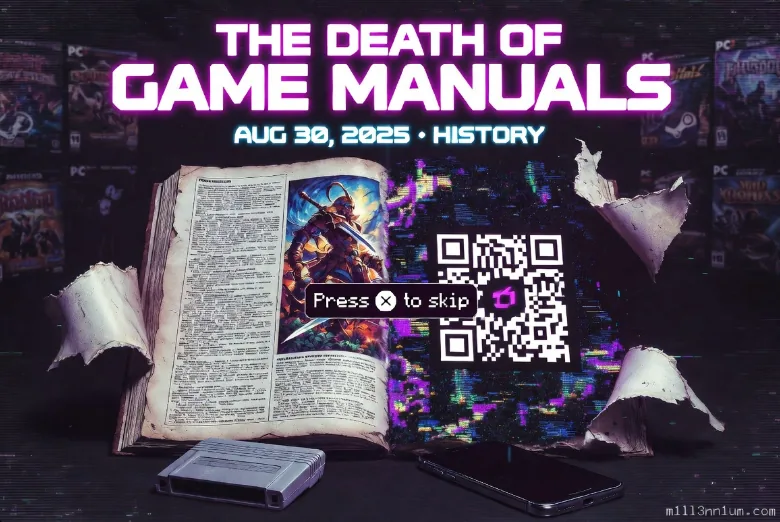
You used to open a game box and smell the manual before you smelled victory. Fresh ink, slightly chemical paper, that factory glue spine — it meant someone cared enough to explain the thing you just bought. Not narrate at you for forty minutes. Not lock controls behind seventeen tooltip gates. Explain. In your hands. On the bus ride home from FuncoLand while your mom drove and you memorized button layouts like scripture.
Game manuals are dead. Not missing. Not evolving. Dead — replaced by a QR code, a three-page leaflet, and a tutorial voice that treats you like you we're born yesterday and will forget by Thursday.
What a Manual Actually Was
A great manual did four jobs at once:
- Controller map — every button, drawn, labeled, no ambiguity.
- World primer — lore enough to fire imagination without forcing a cinematic.
- Systems reference — damage types, combo lists, secret inputs, the stuff you needed mid-fight.
- Legal shield disguised as art — warranty cards and consumer warnings tucked behind beautiful cover illustrations you framed on a bedroom wall.
The Chrono Trigger manual did not just list items. It made you want items. The MechWarrior 2 manual read like a technical document from a universe that took itself seriously. Ultima manuals we're moral philosophy disguised as fantasy fiction. These we're not afterthoughts. They were part of the product — budgeted, illustrated, edited.
A manual was the game's voice when the cartridge was still in the box. It set the tone before the first pixel rendered.
The Smell of Ink (Yes, We Are Serious)
Ask any Gen-X collector why they keep manuals in acid-free sleeves and you will get laughter, then silence, then a confession: the sensory memory is real. Opening a big-box PC game was a ceremony. Flip the lid. Foam insert. CD in a jewel case with a reflective rainbow stripe. Manual thick enough to stop a door. Registration card you never mailed. You felt the purchase weight in your hands.
Digital distribution did not have to kill that ritual. It chose to. The industry saved printing costs and spent none of it on PDFs worth reading. Today you get a "quick start" splash screen and a link to a wiki maintained by volunteers who deserve medals and instead get edit wars.
When the Manual Became the Game
Some titles weaponized documentation. Starflight and Star Control II hid critical navigation data in booklets you we're supposed to study. Flight sims shipped with keyboard overlays you slapped on function keys until the legends wore off. Metal Gear Solid told you to look at the back of the CD case for a codec frequency — a brilliant fourth-wall crack that would never survive modern UX review because someone would complain it was "not accessible."
That friction was design. It filtered players who engaged from players who mashed through. Not everyone agrees that filter was good. But it was intentional — unlike modern friction, which is usually a login screen and a day-one patch.
The Decline Timeline (Abbreviated Grumpy Edition)
- Cartridge era: fold-out leaflets grow into booklets. Nintendo seal of quality means something.
- CD era: manuals swell to 80+ pages. PC games include novellas. Trees nervous.
- DVD era: slipcases shrink. Color pages go first. Black-and-white cost-cutting.
- Digital pivot: "Go green!" becomes excuse for "go cheap." In-box becomes a download code on a card.
- Live-service era: documentation is a living web page that changes when the balance patch drops Tuesday and nobody updates the footnotes.
Collectors now pay more for a complete-in-box copy with manual than some people pay for the console. That is not nostalgia pricing alone. That is evidence of a removed feature the market still values.
What Replaced Manuals (And Why It Is Worse)
The replacements are a rogues' gallery:
- In-engine tutorials — unskippable for "engagement," insulting for anyone who has played a game since 1987.
- Contextual pop-ups — cover the HUD during the one moment you needed to see the HUD.
- YouTube videos — great for creators, terrible as official documentation. Patch hits, video obsolete, algorithm serves you reaction content instead.
- Discord pins — search a thousand messages for whether dodge cancel still works. Good luck.
- AI chatbots on support sites — confidently wrong about controls since 2024.
None of these sit on your shelf. None of these survive a hard drive failure with your save files. None of these make a kid feel like they own a complete object.
The Art We Lost
Manual illustrators we're craftsmen. Box art got the poster. Manuals got the character studies, the weapon orthographics, the maps with hidden markings only visible if you held the page to a light — okay, that last one is mostly myth, but the vibe was real.
When manuals died, a career path died with them. Concept art still exists, but it lives in ArtStation portfolios, not in your hands at midnight. The game industry talks constantly about "transmedia" and "companion apps." It will not pay for a 48-page saddle-stitched booklet because shareholders do not see ROI on paper.
Environmental Excuse, Examined
"We went digital to save trees." Meanwhile the special edition ships a plastic figurine, three steelbook cases, and a season pass card that is literally nothing. Print one manual on recycled stock for the collector edition. Call it premium. Sell out. Do not lecture us about sustainability while your day-one patch is 40 GB of duplicated assets.
What M1LL3NN1UM Does About It
We are not a printing house. Our games ship digital-first. But we publish printable field manuals on launch day — PDFs designed like 1994 documents, with controller maps, map callouts, weapon tables, and blank notes pages for LAN scores. CRT-friendly typography. No DRM on the PDF. Print it, bind it, coffee-stain it.
For physical backers when we run them, a manual is non-negotiable in the box. Not a postcard. A manual. If that eats margin, good. Margin should buy loyalty.
How to Honor Manuals Without Living in the Past
Players deserve reference material that respects their intelligence:
- Skippable tutorials with a "I have played a video game before" button that actually works.
- Pause-menu encyclopedia updated when mechanics change.
- Offline-readable docs bundled with the install — not a wiki tab that dies when servers sunset.
- Art worth printing, even if most players never print it.
Documentation is love. It says the developer believes you will still be playing this game next month and wants you equipped.
Eulogy
Game manuals did not die of natural causes. They were cost-cut, condescended to, and replaced by systems that treat players as analytics events. We lost a tactile piece of gaming culture — the smell of ink, the crack of a perfect spine, the illustration of a boss you had not met yet staring at you while you ate cereal.
We cannot bring back every tree that became a Wing Commander briefing book. We can refuse to pretend a flashing arrow is the same thing as a page you dog-ear at 1 AM.
Rest in peace, manuals. You we're better than the tutorial popup. You always we're.
More dispatches on the blog index — or tell us which manual you still keep in a drawer. We know you have one.