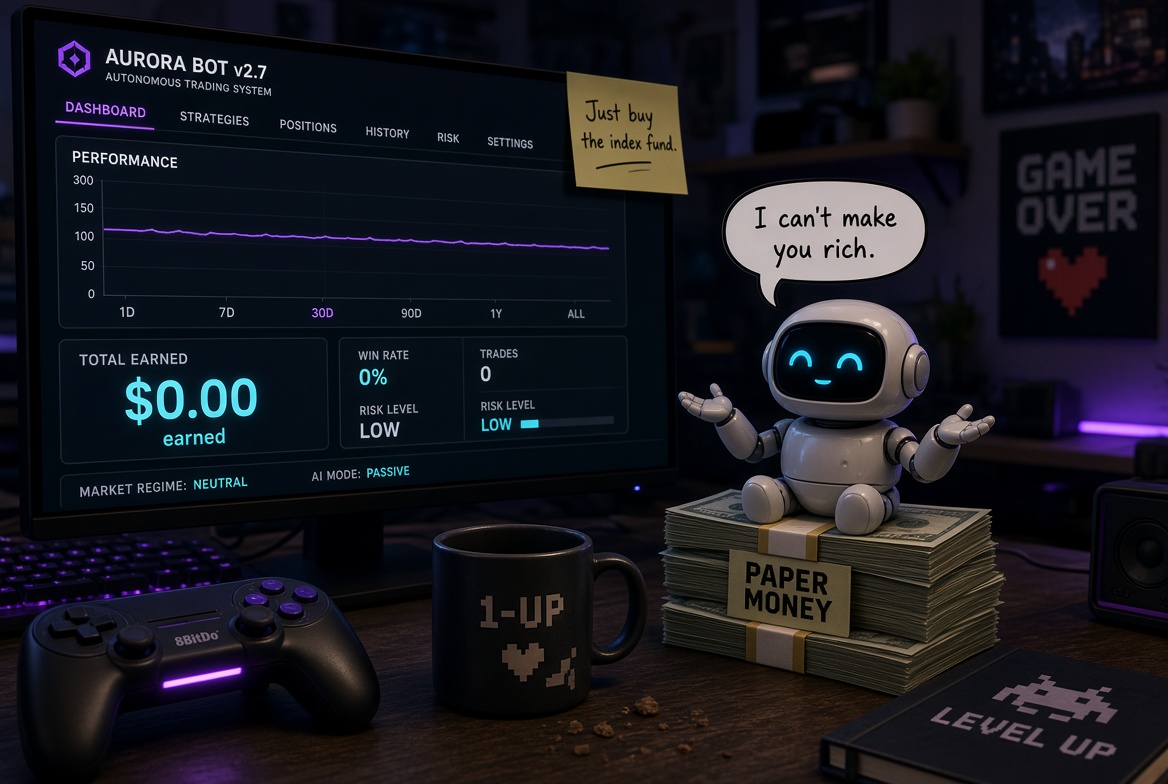
A bot can place orders for you. It cannot create an edge that the market doesn't already pay. I know because I built one, tested it on paper money, and so far nothing in it has beaten simply holding the market.
The Claim
A post on X says that trading bots and AI will make you thousands, or make you rich, in no time and with no effort. Posts like it are easy to find and easy to believe, because the machinery is real: you can connect code to a broker, let it watch prices all day, and have it trade while you sleep.
But the machinery is the easy part. The hard part is knowing which trades are worth making, and no amount of automation answers that. This article uses a real test, with its numbers, to show why.
What I Built
I wrote a personal trading app, about 20,000 lines of Python, that runs on one Windows PC and talks to Webull through its official OpenAPI. It places, changes and cancels orders, runs automated strategies, scans about 510 stocks every five minutes for setups, and backtests rules on past prices.
The test was set up to be hard to fool:
- Paper money only. Real trading is locked behind three separate switches, and none is on.
- A small account on purpose. Webull's paper accounts hold about $1,000,000, so the app imitates a $500 account with a risk limit, including the rule that sale money can't be reused until the next day.
- Every order goes through a risk engine with limits on order size, position size, daily loss and order rate.
- Costs are counted. Backtests include slippage of 5 basis points per market order and the SEC fee on sales.
- Every result is stated with its sample size. A test with fewer than 30 trades carries a warning.
In short, the plumbing works. 334 unit tests pass, and orders reach the broker and fill. That was never the problem.
What the Tests Found
Every short-term rule lost money after costs, and none of the longer-hold rules beat simply holding the market in a form free of hindsight. Over the longer test window (daily bars, 510 stocks, September 2022 to November 2026), holding SPY made 16.3% a year and holding the whole stock list made 17.7%.
| RULE TESTED | SAMPLE | RESULT |
|---|---|---|
| Breakout with trailing stops | 24 stocks, 30 days | Every stop width lost, −0.22% to −0.33% a trade; about 32% winners |
| Breakout, by entry time | 24 stocks, 90 days, 1,238 trades | −0.11% a trade, 35% winners; every group lost, midday worst |
| Opening-range breakout | 1-minute bars, 24 stocks, 48 days | 0.0 R a trade at best, −0.19 R at worst; no edge |
| Exits for scanner dip picks | About 2,250 trades | Every exit lost; average −0.086% a trade, and trailing exits were worse |
| Crypto dips | 89 paper round trips on 2026-11-16 | All 89 lost; paper crypto was quoted about 2% wide |
| 200-day trend rule | Daily bars, SPY and QQQ | Holding made 18.1% and 22.4% a year; the rule made 9.0% and 15.6%, with smaller falls |
| Rotation among 11 sector funds | 2022–2026 | 4% to 15% a year against 19.8% for SPY |
| Daily dip rule, lowest RSI first | 510 stocks, as one account | 9.1% a year, worst fall −31%; loses to holding |
| Daily dip rule, signals picked at random | 510 stocks, as one account | About 6% to 11% a year; loses to holding |
Two more results look much better, and I don't trust either:
- Monthly momentum, top five stocks: 116% to 137% a year. The list is today's large companies, so the test picked from stocks that were already known to have won.
- Daily dip rule, strongest six-month rise first: 30.1% to 36.5% a year. It uses the same list, so it carries the same hindsight. It is a candidate for a fair retest, not a result.
The live paper test of that last rule began on 2026-11-19 with three stocks at $165 each. Before the next open it was down $13.43, or 2.71%, against 1.02% for SPY, with no finished trades. One day proves nothing either way, and the rule has no stop-loss.
The Arithmetic of a Small Account
Even a rule that worked would earn little on a small account, because returns are a percentage and the account is small.
| STARTING MONEY | RETURN IN A YEAR | GAIN |
|---|---|---|
| $500 | 16% (what SPY made in my test window) | $80 |
| $500 | 20% (a strong year of trading) | $100 |
| $500 | 36.5% (the best number in my tests, which I don't trust) | $182 |
To make $1,000 in a year from trading alone, you would need about $5,000 at a steady 20%, or about $6,250 at 16%. Those returns are not steady. One version of the dip rule fell as much as 31% from its peak along the way, and one of my paper positions was down 2.7% on its first day.
Compare that with adding money. Putting in $50 a week is $2,600 in a year, which is more than any of the rows above. For a small account, the deposits matter far more than the strategy. That is not what a post promising riches in no time wants you to hear.
“A Team of Bots Making Me Thousands While I Sleep”
This version of the claim sounds like a team of AI agents trading for you around the clock. I can't audit anyone else's account, but I can say what mine does when I'm not watching, and it is not that.
- It stops when the PC does. All of the automation runs inside the dashboard program. Close the window or let the PC sleep and it stops. On 2026-11-17 the PC was on battery, went to sleep, and the app missed its own 15:50 close-out.
- Overnight is where the risk sits. The only thing that keeps working without the app is a stop order already resting at Webull, and those are day orders that end at the close. The swing test holds three stocks overnight with no stop at all. Its first night cost $13.43 on paper.
- More bots is more of the same rule. I set up 100 coin strategies on 5-minute bars. Every paper round trip I tested on 2026-11-16, 89 of 89, lost money. A hundred copies of a losing rule is not a team. All 100 are now off.
- An AI can write the code, not the edge. Assistants helped me build the plumbing. When I put my results to two of them, both said the same thing: at this size the deposit matters more than the strategy, and nothing I tested had beaten holding the market.
I also tried the blunt version. I told Grok it had $100 and asked it to earn me passive income, or delete itself. Grok told me, personally, that it can't. Its answer was that it can't promise any return on $100, that there is no hands-off way it can turn the money into reliable income, and that “anyone who claims they can is selling something.”
Its alternative was to spend the $100 on promoting my own projects, with it planning the posts while I keep control of the money. That can be a fine use of $100, but it spends the money. It is not a way to make money in my sleep.
The assistant people point to as proof that AI earns while you sleep says in plain words that it can't.
So the honest description of “while I sleep” is a program that stops when the laptop does, holds risk overnight, and has so far lost on paper. If someone says their bots earn thousands in their sleep, ask what the bots held overnight, what the account was worth, and how it compares with holding an index fund over the same dates.
What the Bots Actually Earned: $0
The stock bot isn't the only AI work I've done. I also had two assistants working on my gaming site and clan, and here is the full receipt as of 2026-11-20.
What got built:
- A shop page and a gear page with 14 Amazon links and the required affiliate disclosure.
- An Etsy shop with three print-on-demand products: a mouse pad at $9.99, a desk mat from $17.86, and a T-shirt at $28.99.
- A gift-guide blog post, plus a weekly guide routine and a weekly merch routine, both set to start on 2026-11-23.
- Two digital products, a printable scorebook at $11 and a wallpaper-and-poster kit at $9, packed for Gumroad.
- A cleanup of about 5,000 junk emails, moved to Trash so they can be recovered.
What it has earned: $0. No Etsy orders, no affiliate commissions, and the digital products aren't confirmed live. If a sale exists, I haven't seen it.
Why: The audience is small, about 77 YouTube subscribers and about 490 on X when the work started, plus 200-plus Twitch followers. An assistant can research products, write pages, package a PDF and draft posts. It can't make a stranger click Buy, and it can't skip the applications, disclosures and approvals. Nothing goes live without my yes, on purpose.
Meanwhile the stock side stays parked: connected, no real-money trades, and none without my explicit approval.
That is less exciting than “I gave a bot $100 and told it to make me money.” It also has the advantage of being true.
Why the Claims Look Convincing Anyway
My own tests produced numbers like 116% a year, so I can see how a screenshot like that gets posted. Each of these traps showed up in my work or sits one step away from it:
- Hindsight lists. My momentum test picked from today's large companies. Stocks that became big had already won, so the test is partly a list of winners. Any backtest on “the best stocks” has the same problem.
- No costs. A rule that looks fine before slippage, fees and spreads can lose after them. None of my intraday rules made money after costs, and paper crypto loses about 2% on the spread alone.
- Too few trades. A strategy that looks great over 10 trades says very little. My own rule is to warn below 30 trades.
- Picking the window. A rule can look excellent over one stretch of the past and fail over the next. I tested one four-year window.
- Paper fills. The sandbox fills orders in about a second at the quote. Real fills can be worse.
- Showing the winners. A screenshot of one good week doesn't show the other attempts, or the weeks that followed.
None of this takes dishonesty. It takes only an enthusiastic person with a backtest and no one checking it. When someone is also selling a course, a signal service or a bot, they have a reason to keep the checking from happening.
Questions to Ask About Any Bot Claim
- Is the money real or paper? Paper results skip real fills, partial fills and slippage.
- How many trades are behind the number? Under 30 is an anecdote.
- Were fees, spreads and slippage counted, and where did those figures come from?
- What was the list of stocks, and was it chosen with hindsight?
- What did simply holding SPY make over the same dates?
- What was the worst fall along the way, and could you have sat through it?
- Is the person selling something, such as a course, a signal service, a bot or a referral link?
- Does the claim say what it would earn on $500, not only as a percentage?
What I'm Doing Instead
The bot stays a lab. It does not trade real money, and the paper test keeps running at no cost.
My written rule is that real money belongs in a broad index fund until a paper test beats SPY over at least 30 finished trades. The deposits, not the strategy, are what grow a small account.
The result that would change my mind is specific. I would rerun the daily dip rule on a list of companies that were already large at the start of the test, not on today's winners. If it still beats holding the fund across at least 30 finished trades, with costs counted, that is worth a closer look. If it doesn't, I drop it, which is what the test's own rules say.
Limits of This Test
This is one person's test of a few rules over a short stretch of history, so it doesn't prove that no bot can ever make money. It shows that these rules, tested honestly, didn't, and that the claim of easy riches has to meet the same standard.
- The data covers at most 180 days of intraday stock bars and 5 years of daily bars.
- Dividends are probably not included, and a few daily bars are bad.
- The live swing test has no finished trades yet.
- Paper fills are easier than real ones.
NOT FINANCIAL ADVICE
This article is not financial advice. I'm not a licensed advisor, and past results, including mine, are not a forecast.
No Quarter — Still Angry
— M1LL3NN1UM
Field Dispatch #04 // November 20, 2026
Previously: The Chart They Showed Portal Holders (#03) · Eleven Line Items, Zero Finished (#02) · EST 1987. From the trenches of the 80s. Be cool or get muted.